







How do I say what is difficult?
Ask for a raise, give feedback, decline a demand. You walk away with what you're going to say and what to do if the answer is no.

Talk to an AI to organize what's difficult and prepare what you want to say. With access offered by your company and privacy for you.
See it in actionOffered by your company. Using it is your choice.
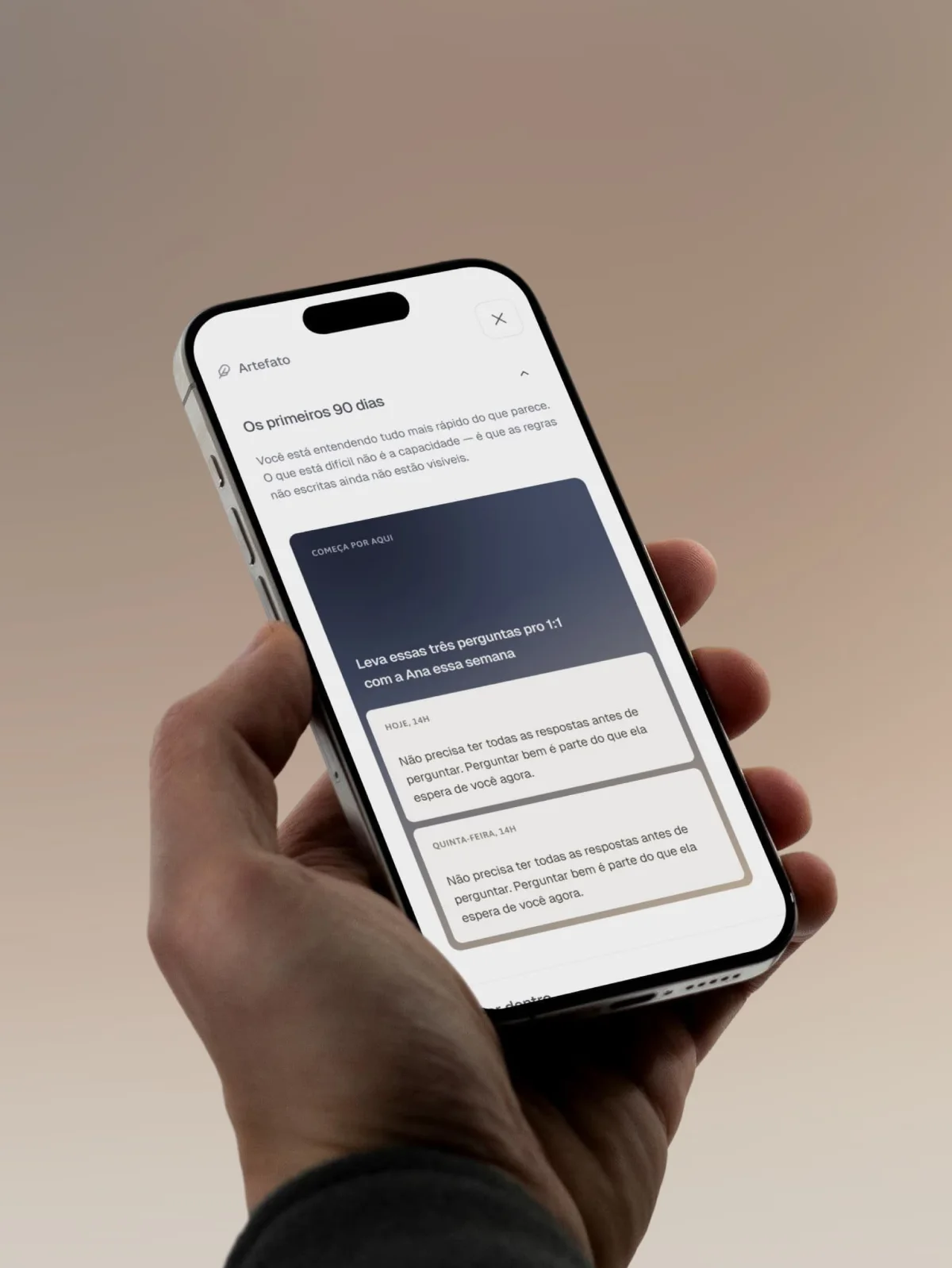
You said you would find a way, and you did. The new delivery came in and nothing else came off the list, because no one agreed on what should move. What remains is the feeling that you should have organized yourself better.
Amia helps you get the full list out of your head. Once the workload is visible, you can show what fits by Friday and what needs to wait to the person who decides priorities.
You leave with the sentence prepared and decide whether to use it. Nothing leaves this space unless you choose to take it with you.
 Private space
A CONVERSATION ABOUT YOUR DAY
PREPARE THE CONVERSATION
A possible opening
“With the new delivery, I need to revisit what fits by Friday. I would like us to agree on what remains a priority and what can wait.”
Before the conversation
Bring the current list and the time each item requires. The priority decision belongs to the manager; the complete picture is what you bring.
Illustrative example. The real conversation adapts to what each person brings.
You can prepare a conversation without HR or your manager receiving what you have written. The company offers access; your conversations, records, and drafts stay in your space.
Identity and content are separated. Conversations are stored with encryption, and technical access is restricted.
Amia uses an AI provider to process the conversations, and there are restricted technical accesses. See who can access the data and under what conditions.
Using Amia is your choice. Participation is voluntary and cannot affect evaluations, promotions or HR decisions.
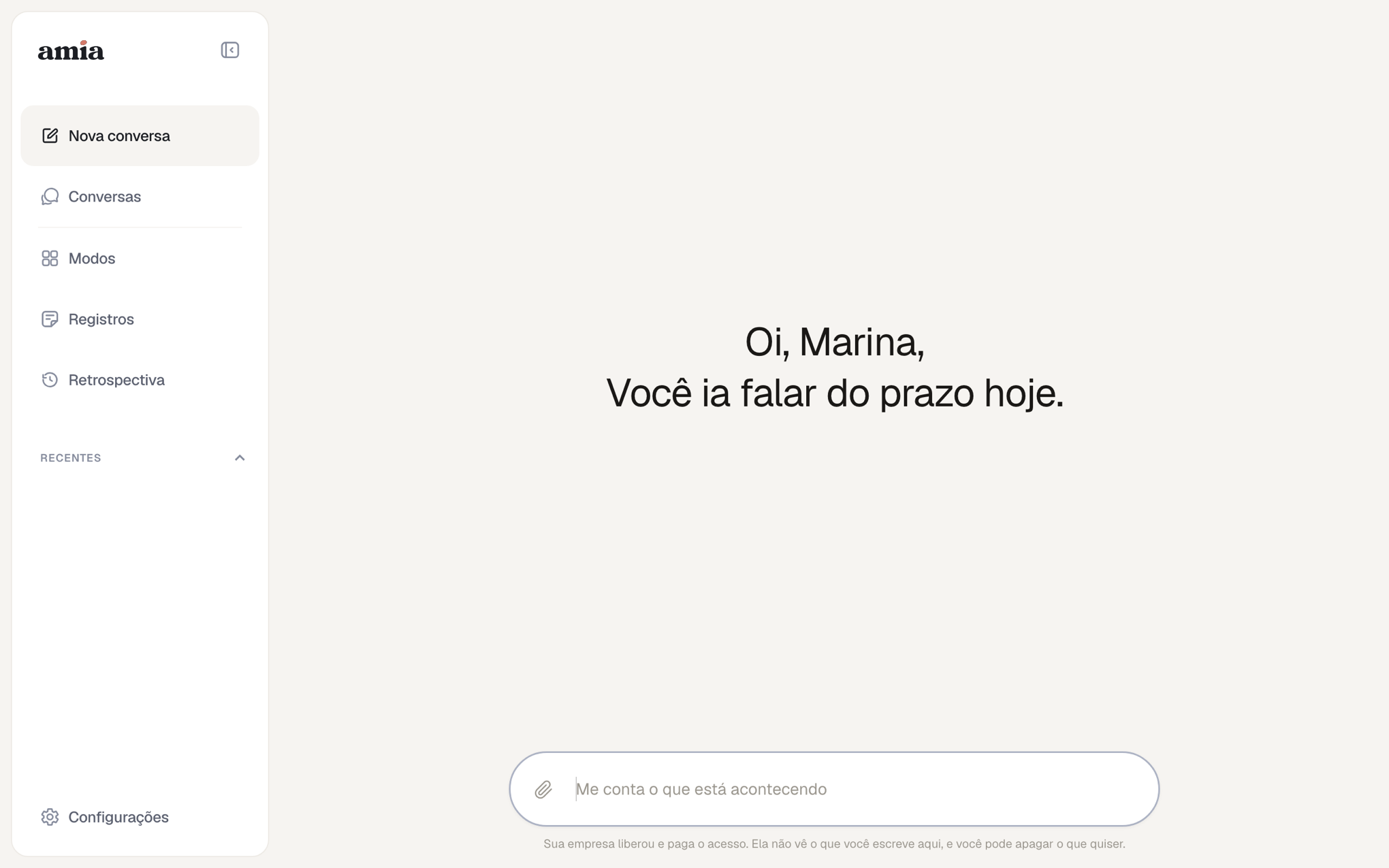
You can return to say how the conversation went, revisit a decision or think through what changed. Amia uses the context of earlier conversations to continue from there.
Ask for a raise, give feedback, decline a demand. You walk away with what you're going to say and what to do if the answer is no.

What was said, what you heard and what you want to clarify before answering. They are not always the same.

Recognize a delivery, point out what needs to change, and agree on the next step. Amia helps the manager prepare a clear conversation, with examples and space to listen.

Stay, leave, change area. What you gain and lose on each path, and what you still need to know before choosing.

Three open deliveries, one more arriving, and the feeling that you should be able to handle it all. Amia helps prepare a request for priorities using the time each item requires.
Talk about what happened without forcing a conclusion. Not every conversation needs to end in a plan.
A promotion, a new area, the first team to lead. The questions that make you ashamed to ask in the third month.
A dilemma with similar weight choices. Put gains, losses, and what matters to you side by side until you come to a decision map.

The direction is given, but the path is missing. Organize priorities, dependencies, and next steps into a strategy and execution map.

Gather deliverables, context, and development points from someone on the team. Prepare an evaluation of the period with concrete examples, in addition to the most recent impression.

What was said, what you felt and what you concluded are three things. Amia asks until they are separated.
A deadline that was too short, an expectation that no one agreed on. When the source is in the process, Amia says so, instead of asking you to adapt.
Compare the options, choose a path and leave with something usable, such as a conversation outline or a message draft. The decision is yours.
The company receives information about the benefit. The content of your conversations is not shared with HR or managers.
The dashboard tracks licenses and usage totals. Usage numbers only appear from 30 people who have used Amia.
The quarterly signal brings together counts by theme, with protection for small groups. It does not show names, areas, managers or the content of a case. Employees and HR see the same report.

Amia is an AI and says so. When there are signs of serious distress or risk, the conversation changes course: safety comes first, and the person is directed to human support.
It points to concrete support in Brazil: a psychologist, a doctor, CVV at 188 during a crisis, or SAMU at 192 when the risk is immediate. The company is not notified, even in a crisis and even though it provides access.
It does not diagnose, replace therapy or act as a formal reporting channel.
Understand the scopeAmia Work is an artificial intelligence application for thinking about work situations, preparing conversations and organizing next steps. Access is provided by the company, and participation is voluntary.
The company tracks aggregate information about the benefit, without receiving the content of individual conversations.
Access to Amia Work is offered by the company. If your company already participates, ask HR for access guidelines. If you don't participate yet, you can share the presentation for companies. The standard product is not available outside Brazil today. If an organization elsewhere is interested, we can explore a partnership based on language, legal, privacy and support requirements.
The contracting company, HR and managers do not receive individual content. Identity and content are separated, and content is encrypted at rest.
Amia uses an external provider to process conversations. There are restricted technical accesses and specific retention and review conditions by the provider. Therefore, privacy does not mean the absolute absence of human access. See details in the privacy policy.
Conversations, records and memory remain in each person’s private space. The report groups company-wide counts protected by minimum publication thresholds. It does not show names, teams, managers or the content of any case.
Fewer than 10 people: the number is hidden. From 10 to 29: a range of ten appears. From 30: exact number and recurrence may appear; the comparison depends on a previous basis.
The protection also considers who is outside each count. If subtraction could reveal a small group, the figure becomes less precise or the line is hidden. Companies with fewer than 30 licenses do not receive figures in the signal.
A person is counted once in each theme and may appear in more than one. The figures therefore should not be added together. The signal describes the people who chose to use Amia; a hidden line does not mean that no issue exists.
In three layers. In the architecture, identity and conversation content are stored separately, and content is encrypted at rest. Access to one does not provide access to the other.
At the AI provider: conversations are processed under a data processing agreement. The provider does not use the content to train models and retains it for a limited period solely to prevent abuse. The retention periods are described in the privacy policy.
In the agreement: the company contract includes a data processing addendum that prohibits combining Amia use with HR processes. Amia maintains the impact assessment and processing records required by the LGPD, and you can exercise data subject rights such as access and deletion directly with Amia, without going through your employer.
Under the Amia Work policy, conversation content is not used to train or improve the provider’s models. Retention periods for abuse prevention and the processing conditions are described in the privacy policy.
No. Participation is voluntary and this is written into the contract: the company agrees not to require or pressure people to use Amia, and using or not using it cannot affect evaluations, promotions or any HR decision.
Amia offers support to think about work situations. It does not replace clinical care, technical risk assessment, GRO/PGR or legal guidance. It also does not guarantee compliance with NR-1. Know the product terms and limits.

Access is provided by your company. The product currently operates in Brazilian Portuguese and is structured for organizations in Brazil.