






The benefit is
being used?
Licenses, Aggregate Use and Invoice. The pilot dashboard shows usage totals from 30 people.
Pilot Dashboard
A private AI for teams to prepare for difficult conversations at work.
ExploreA company benefit. A private space for each person.
Burnout leave takes someone away for weeks and brings them back still recovering. An unexpected departure costs months of salary to replace. A lawsuit costs more and arrives a year too late.
Before any of those three outcomes, there is often a conversation that was postponed because someone did not know how to begin.
Thinking through a difficult conversation before it happens is what an executive buys in consulting hours. Amia gives that preparation to everyone on the team, at a per-person cost that belongs in the same comparison.
 Private space
A CONVERSATION ABOUT YOUR DAY
PREPARE THE CONVERSATION
A possible opening
“With the new delivery, I need to revisit what fits by Friday. I would like us to agree on what remains a priority and what can wait.”
Before the conversation
Bring the current list and the time each item requires. The priority decision belongs to the manager; the complete picture is what you bring.
Illustrative example. The real conversation adapts to what each person brings.
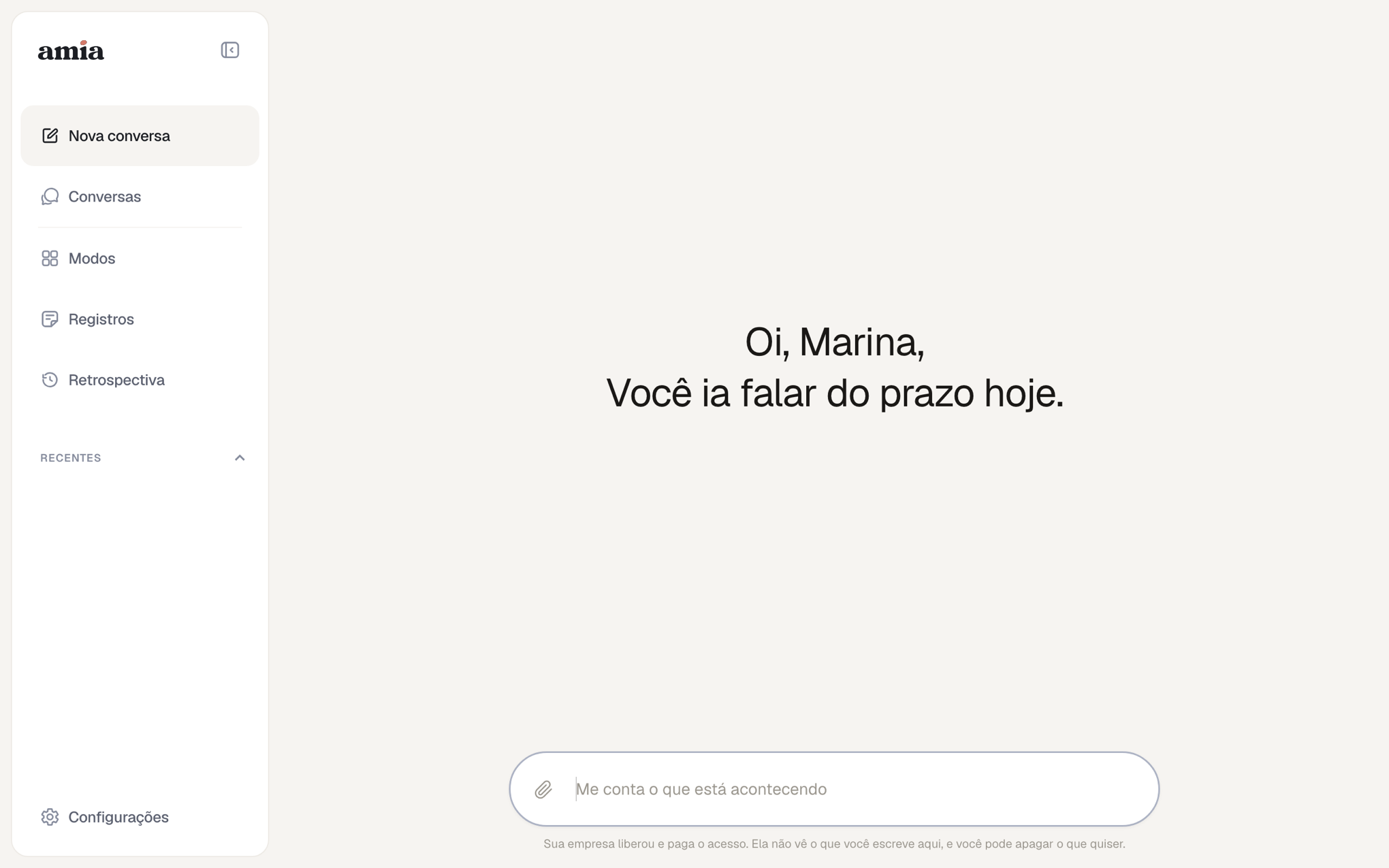
Each conversation leaves something agreed or open. When the person comes back, Amia starts there, and that's what makes the second conversation happen.
The company tracks licenses, aggregate usage, and invoice. Usage totals appear from 30 people.
This example uses dummy data.
In the quarterly signal, employee and HR see the same report.
Each theme counts only the people who brought up that topic. Even when many people use Amia, a theme can gather fewer than ten and have its number hidden.
Protection also considers who was out of count: if the number allows you to deduct a small group, it appears less accurately or is hidden.
A person can appear in more than one theme. Therefore, the numbers should not be added. A hidden theme does not mean no problem.
The person gains space to think about the work. HR gains pathways to track the benefit, recognize collective issues, and facilitate conversations that need to happen.
Deadlines, pressures, and expectations don't go away when they run out of conversation. Amia helps the person understand what is difficult and prepare what they need to say. Thus, the manager has the opportunity to listen, review priorities and agree on a next step.
Select a theme to see if it reappears and what questions HR can ask. Even in situations of conduct, the report helps to guide attention without identifying cases or opening complaints.
How we protect privacyLicenses, Aggregate Use and Invoice. The pilot dashboard shows usage totals from 30 people.
Pilot DashboardSix themes, recurrence and next steps. The signal helps HR choose what to investigate.
Quarterly signalThe planned route prepares the report and points out the formal channel. The person reviews and decides whether to submit.
Route to the formal channel · in design
The report helps HR realize what deserves attention. We are designing a way for the person to prepare a report, review it and decide whether to send it to the formal channel. The company receives and ascertains. Before sending, Amia explains the identification conditions: the email identifies the sender, and the details can also reveal who writes.
Separate facts, interpretations, and what the person wants to ask for.
See the address, identification conditions, and what details of the text may reveal who reports.
The person copies the report and opens the company channel. They send it themselves, outside Amia.
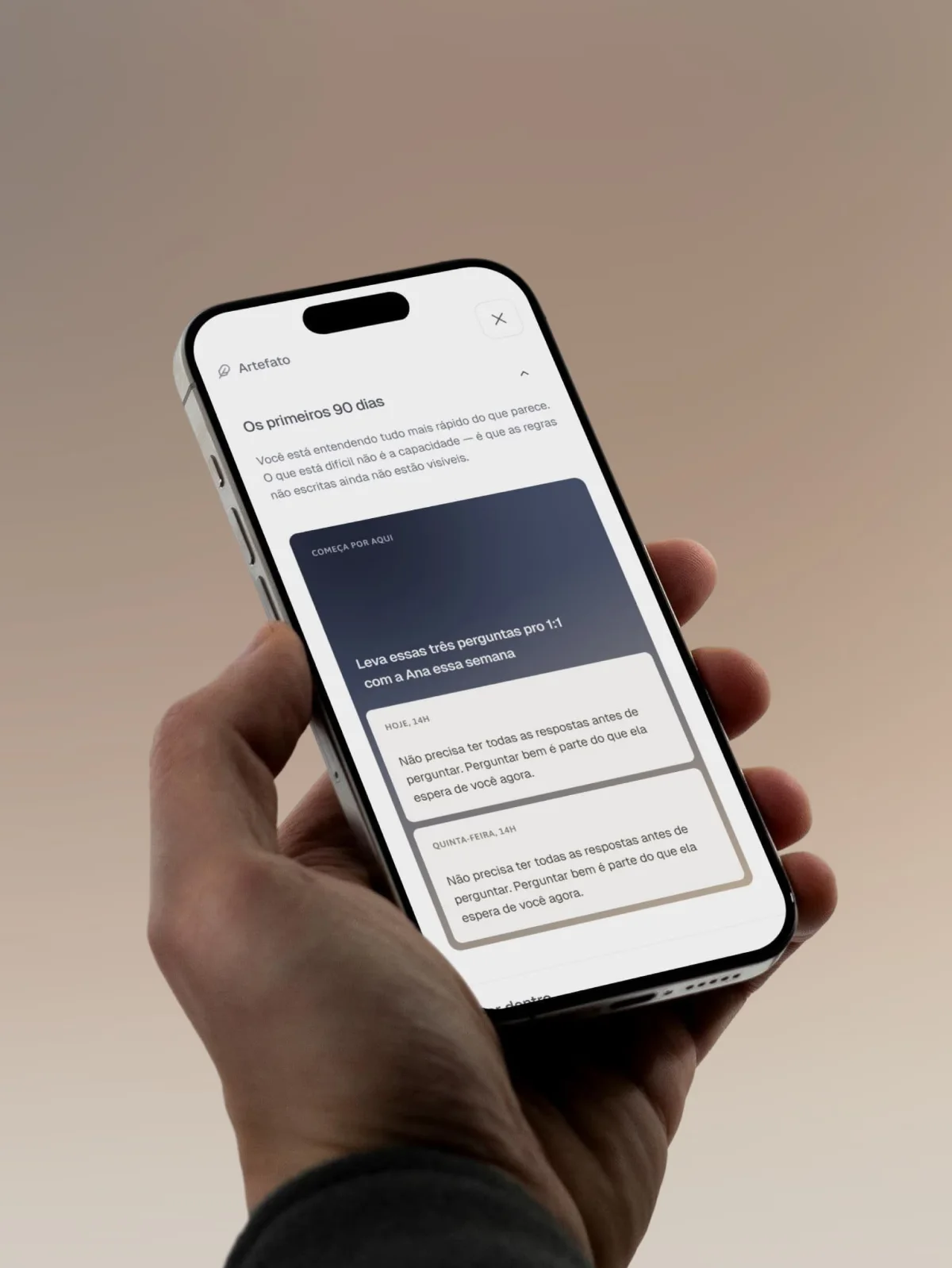
Speaking freely requires confidence. Amia protects the privacy of those who talk: the company offers access, but does not receive conversations, records or drafts.
Identity and content are separated. Conversations are stored with encryption, and technical access is restricted.
The company pays for a tool that deliberately does not provide individual visibility into who uses it. That boundary is what makes the product work.
The protocols were reviewed and approved by the legal team and an occupational safety psychologist.
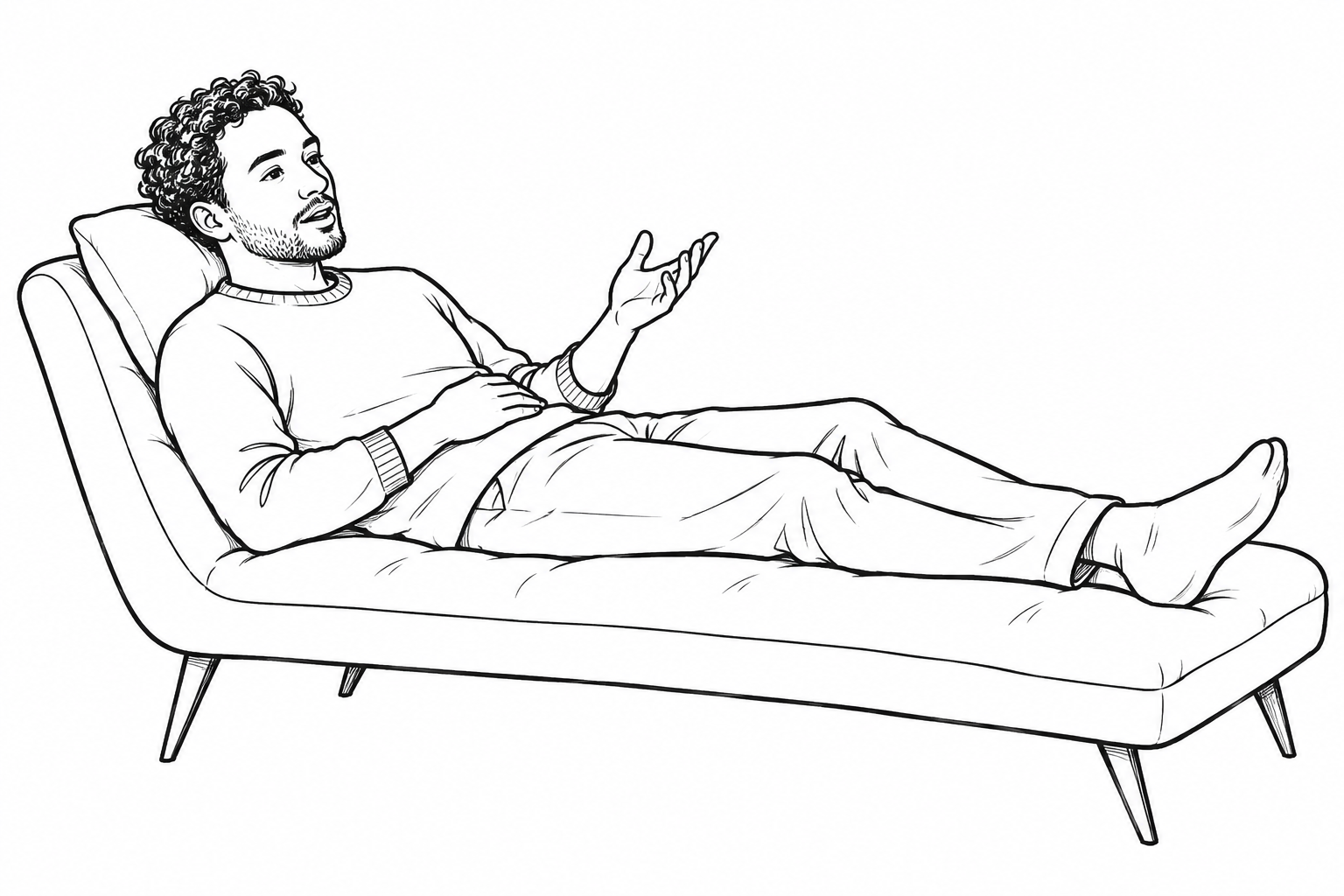
Amia is an AI and says so. When there are signs of serious distress or risk, the conversation changes course: safety comes first, and the person is directed to human support.
It points to concrete support in Brazil: a psychologist, a doctor, CVV at 188 during a crisis, or SAMU at 192 when the risk is immediate. The company is not notified, even in a crisis and even though it provides access.
It does not diagnose, replace therapy or act as a formal reporting channel.
Understand the scope
What was said, what you felt and what you concluded are three things. Amia asks until they are separated.
A deadline that was too short, an expectation that no one agreed on. When the source is in the process, Amia says so, instead of asking you to adapt.
Compare the options, choose a path and leave with something usable, such as a conversation outline or a message draft. The decision is yours.
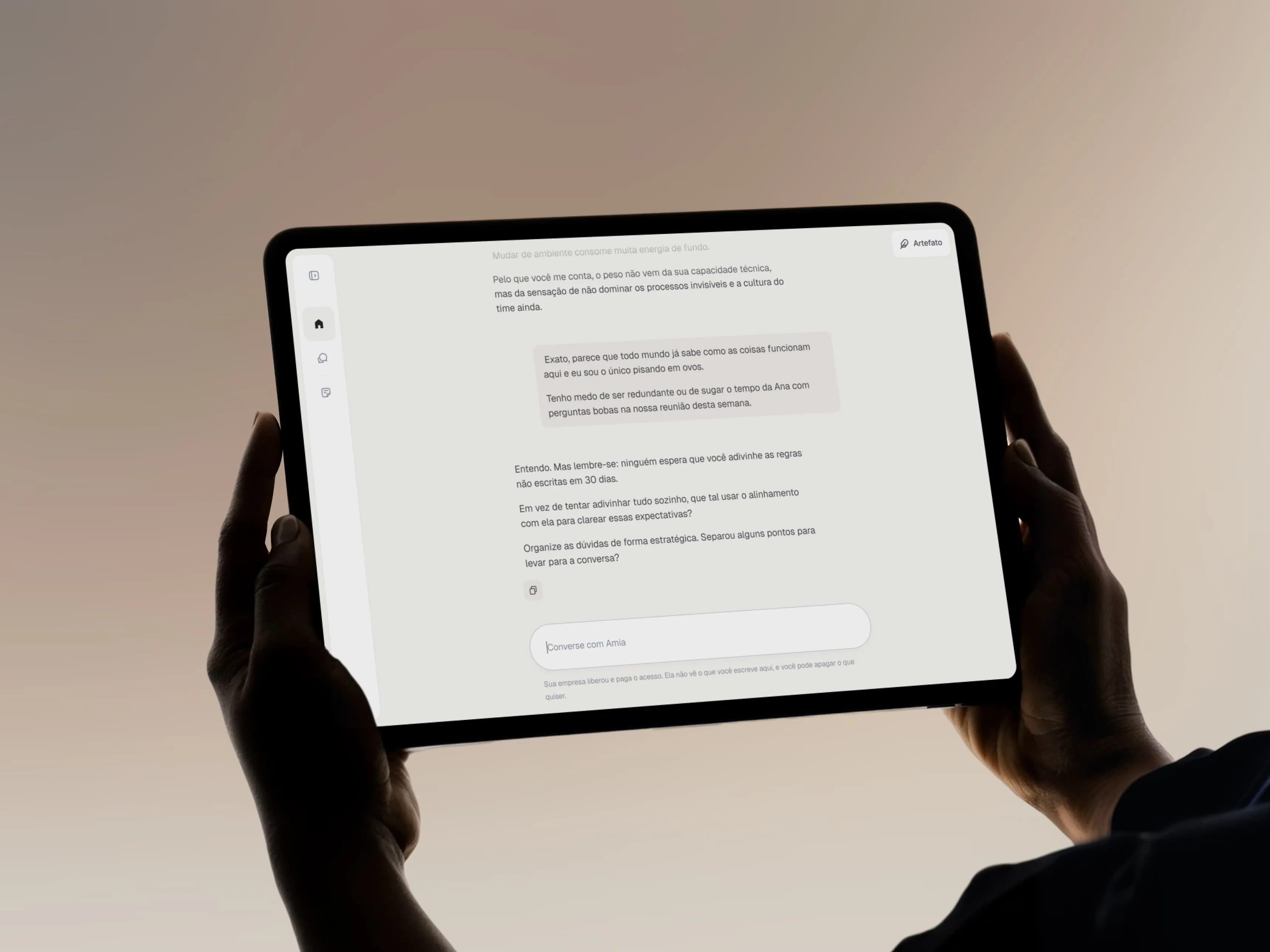
Ask for a raise, give feedback, decline a demand. You walk away with what you're going to say and what to do if the answer is no.
What was said, what you heard and what you want to clarify before answering. They are not always the same.

Recognize a delivery, point out what needs to change, and agree on the next step. Amia helps the manager prepare a clear conversation, with examples and space to listen.
Stay, leave, change area. What you gain and lose on each path, and what you still need to know before choosing.
Before blaming yourself for being disorganized, measure the workload. If it does not fit, the conversation is about priorities, and Amia helps prepare the request.
Talk about what happened without forcing a conclusion. Not every conversation needs to end in a plan.
A promotion, a new area, the first team to lead. The questions that make you ashamed to ask in the third month.
A dilemma with similar weight choices. Put gains, losses, and what matters to you side by side until you come to a decision map.
The direction is given, but the path is missing. Organize priorities, dependencies, and next steps into a strategy and execution map.

Gather deliverables, context, and development points from someone on the team. Prepare an evaluation of the period with concrete examples, in addition to the most recent impression.
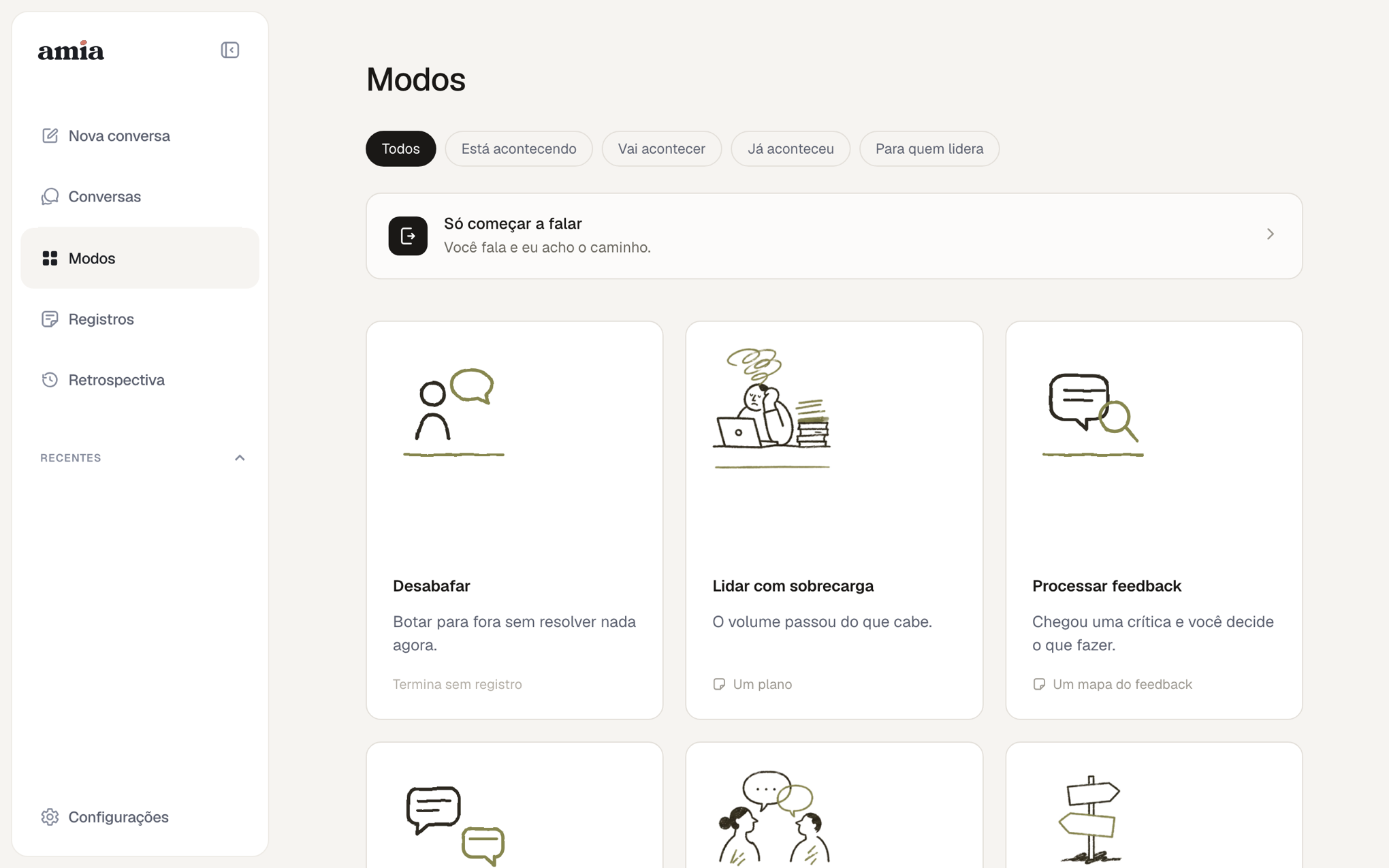
The person does not need to know how to conduct a conversation with an AI. She chooses where she is, and Amia enters knowing what that encounter needs to produce.
Each door ends in something you can use later: a plan, a roadmap, a decision map. Those who prefer to just talk start with the first line, without choosing anything.
Part of the doors is from the leader's seat: giving feedback, evaluating a period, preparing a difficult conversation.

You can go back and tell me how it went. Today's conversation knows the one from two weeks ago: you don't explain everything again, and what you've already told weighs on the answer.
“Tomorrow I'll talk
about priorities.”
“How was the conversation?
What did you agree on?”
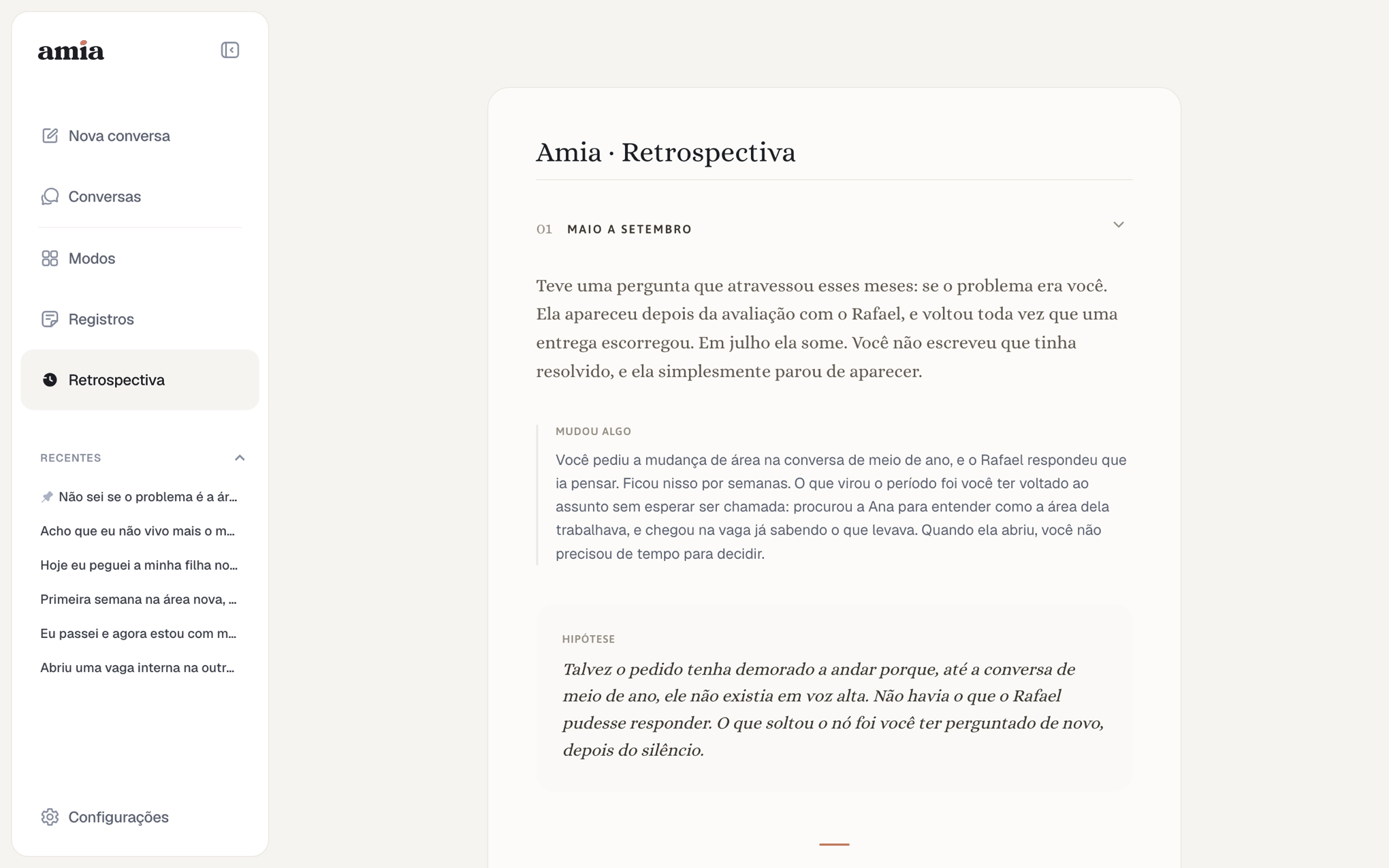
Amia rereads the conversations of the period and returns a reading in running text: what has changed, what has returned more than once, and what the person solved without recording that they had solved.
The retrospective stays with the person. Her text does not go to the company.
Amia Work is an artificial intelligence application from Amia Interactive to think about work situations, prepare difficult conversations and organize next steps. Access is provided by the company, and participation is voluntary.
The company tracks aggregate information about the benefit, without receiving the content of individual conversations.
Conversations, records and memory remain in each person’s private space. The report groups company-wide counts protected by minimum publication thresholds. It does not show names, teams, managers or the content of any case.
Fewer than 10 people: the number is hidden. From 10 to 29: a range of ten appears. From 30: exact number and recurrence may appear; the comparison depends on a previous basis.
The protection also considers who is outside each count. If subtraction could reveal a small group, the figure becomes less precise or the line is hidden. Companies with fewer than 30 licenses do not receive figures in the signal.
A person is counted once in each theme and may appear in more than one. The figures therefore should not be added together. The signal describes the people who chose to use Amia; a hidden line does not mean that no issue exists.
The current pilot dashboard brings together licenses, aggregate usage, and invoice. The quarterly signal is also available. The route to the formal channel is in drawing. The interactive report on this page is a demonstration with fictitious data.
On the proposed route, Amia helps prepare the report. The person reviews, chooses what to share and sends it through the company channel, outside Amia.
The signal groups themes from conversations people initiated themselves. A survey asks questions of a defined audience. They use different samples: the signal helps HR choose what to investigate further, while HR uses its own tools for that investigation. The figures do not automatically represent the whole company.
The report offers guidance for each theme: questions for a short team survey and structural actions to consider. HR can investigate workload, role clarity or processes through the company’s own channels, without trying to identify who spoke with Amia.
The contracting company, HR and managers do not receive the individual content of the conversations in Amia Work. The product separates identity and content, and the content is encrypted at rest.
Amia uses an external provider to process conversations. There are restricted technical accesses and specific retention and review conditions by the provider. Therefore, privacy does not mean the absolute absence of human access. See details in the privacy policy.
In three layers. In the architecture, identity and conversation content are stored separately, and content is encrypted at rest. Access to one does not provide access to the other.
At the AI provider: conversations are processed under a data processing agreement. The provider does not use the content to train models and retains it for a limited period solely to prevent abuse. The retention periods are described in the privacy policy.
In the agreement: the company contract includes a data processing addendum that prohibits combining Amia use with HR processes. Amia maintains the impact assessment and processing records required by the LGPD, and you can exercise data subject rights such as access and deletion directly with Amia, without going through your employer.
Under the Amia Work policy, conversation content is not used to train or improve the provider’s models. Retention periods for abuse prevention and the processing conditions are described in the privacy policy.
Not as a standard offering today. The product currently operates in Brazilian Portuguese and its contracts, privacy model, support and operations are structured for Brazil. If there is genuine demand elsewhere, we can explore a partnership and assess the required language, legal, privacy and support conditions.
No. Participation is voluntary and this is written into the contract: the company agrees not to require or pressure people to use Amia, and using or not using it cannot affect evaluations, promotions or any HR decision.
Amia offers support to think about work situations. It does not replace clinical care, technical risk assessment, GRO/PGR or legal guidance. It also does not guarantee compliance with NR-1. Know the product terms and limits.
During the pilot, for a limited period, the company only covers the cost of AI. The budget is shared by the team, and HR tracks the total spent without seeing individual consumption.
Amia Work is in the pilot phase with selected companies. For a limited time, the company only covers the cost of AI, without a license by name: a volume of use shared by the team. HR keeps track of each person's budget and never their usage.
The pilot is evaluated without opening any conversation: how many people joined, how many returned and what they chose to share. The criteria are agreed before the pilot begins.
Amia is complementary, with a written limit. It does not issue a diagnosis, report or psychosocial risk mapping, and does not replace GRO, PGR or legal guidance. These responsibilities continue with the company's qualified professionals.
At the individual level, Amia delivers a space for reflection that the company does not access. In the collective, an aggregate signal with a minimum of people per line.
The protocols were reviewed by the legal team and an occupational health psychologist. The terms xd privacy policy describe retention, technical access and data subject rights.
You can see adoption and return: how many people entered, how many came back, and what themes kept coming back in the quarterly signal.
On a day-to-day basis, the pilot can observe if people are able to prepare conversations and organize next steps. When someone brings a difficulty to the manager with what they need to say prepared, there is an opportunity to review priorities and agree what to do.
Amia does not promise a drop in turnover or leave, and no pilot has enough time to say so.

We are selecting organizations in Brazil for the pilot. Amia Work is currently structured for organizations in Brazil and is not available as a standard international offering today. If there is genuine demand outside Brazil, tell us about your organization and we can explore a partnership.